May 2024 - Present
Project Duration: Ongoing
Position: UX Designer
Other Team Member(s): Ashmeet Saggu (UX Designer)
Tool(s): Figma, Miro, Notion
How might we make reading more fun for readers and non-readers?
Design a book club with gamified features, allowing users to organize a comprehensive book club experience while earning XP.
About
What is Bound?
Problem Statement
What problem is Bound solving?
Solution
How will Bound solve the problem?
Bound is a social, gamified, book club app that promotes reading by allowing users to compete to see who can gain the most XP (experience points). The aim is to get more people excited about reading and achieving their reading goals.
Our quantitative and qualitative research showed that 75% of the people that responded to our survey, have reported to have never participated in a book club. The other 25% of people reported that when they have participated in a book club, 38.1% of them met monthly. We also found that 60% of the responders have rarely, if ever discussed books with others.
Users are generally interested in reading, saying that if their roadblocks were mitigated, that they would use a book club app. Those roadblocks include: lack of time, lack of accountability, poor organization, difficulty finding clubs, and uninteresting book selections.
Bound aims to make all of those roadblocks disappear, by providing: quick and easy reading tracking, the ability to receive daily reminders, a simple UI that makes book club creation and management seamless, a social network that connects you to friends so you can start book clubs, an AI that recommends you the perfect book, and most importantly, a ranked XP system that gamifies the whole experience.
Design Process : E.D.I.P.T

1
2
3
4
5
Step 1
Empathize - User Research, Data Analysis & SWOT Analysis
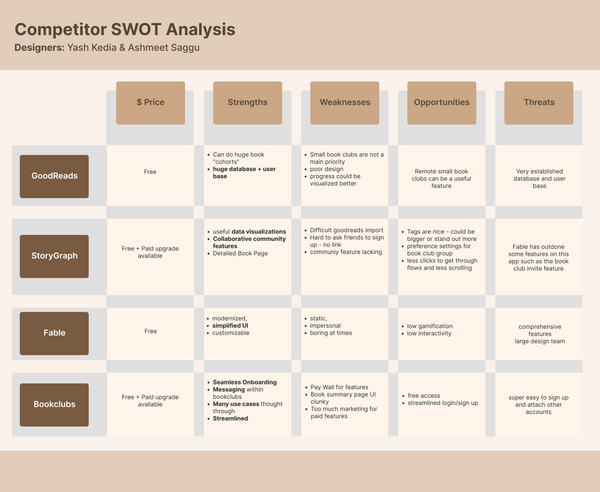
Our first step was to conduct research in order to empathize with our users, followed by identifying and analyzing competitor's strengths, weaknesses, opportunities and threats so that we can better address our own users wants, needs, and pain points.

Data Collection, Analysis & Visualization
44 Responses total
Ages: 20-60
Occupations: Financial Analysts, Engineers, Accountants, IT, Public Relations, Software Developers, Teachers, Students
Locations: California, New York, New Jersey, Illinois, Florida, Mumbai

SWOT Analysis
Competitors of Interest:
1. Goodreads
2. Storygraph
3. Fable
4. Bookclubs
Step 2
Define - User Persona & Journey Map
The next step is to identify who our users are, what they represent, and what they want and need from the product we are making. This will then inform our understanding of the user's journey while using our product; a valuable step in making a highly usable app.
User Persona

Step 3
Ideate - User Flow & Storyboard
Now we get to rainstorm the "routes" the user will take when using our product. This will result in a network of connections between these routes, which lays the the first design brick of in our design process.
User Flow

Storyboard
Illustrated by Ashmeet Saggu
Written by Yash Kedia

Step 4
Prototype -
-
Step 5
Test -
-